AR9 Reliability Blueprint: The Complete 9mm Defensive AR Guide
Platform: 9mm AR-pattern defensive carbine (AR9)
Version: 1.3 (March 2026 Update)
Introduction
This guide defines a practical, reliability-first process for configuring a 9mm AR-pattern defensive carbine (AR9). The objective is to produce a safe, dependable setup with clear part-selection logic and verification discipline—not a parts list built around marketing claims or trial-and-error assembly.
What You Are Setting Up
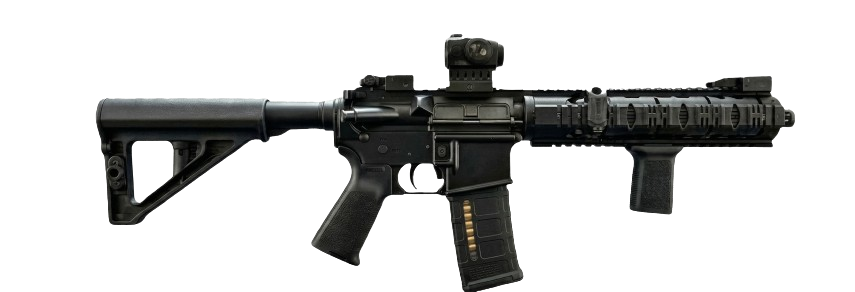
Example of a 9mm AR-pattern defensive carbine similar to the configuration described in this guide. Exact parts and accessories in your final setup may differ.
By the end of this guide, you will have a documented configuration plan for a platform that is:
- Built around a 9mm AR-pattern architecture with familiar AR controls
- Tuned for reliability using magazine, bolt/buffer, and chamber priorities
- Configured for realistic defensive and training use (not showpiece assembly)
- Validated with a setup, zeroing, and verification workflow
Who This Guide Is For
This guide is for civilian shooters, students, and trainers who want a structured framework for selecting and validating a 9mm defensive carbine configuration.
It is not a substitute for legal advice, manufacturer instructions, or licensed gunsmith services.
How to Use This Guide
- Start with Sections 1-3 to establish architecture and reliability priorities
- Use Sections 4-8 to select parts based on role and constraints
- Use Sections 9-11 to configure the carbine and define readiness standards
- Use Sections 13-18 to visualize options, document selections, verify setup, and finalize your blueprint
Why AR9 Setups Fail (What This Guide Prevents)
Most frustrating malfunctions trace back to system interactions, not a single “bad part.” In blowback AR9s, reliability is dominated by magazine presentation, bolt speed (buffer, spring, mass), chamber and ammo compatibility, and last-round bolt hold-open (LRBHO) geometry—long before optics or furniture matter. This guide treats those layers as the product: you document decisions, test deliberately, and verify instead of guessing.
Legal & Safety Disclaimer
This guide is intended for educational and informational purposes only. It is not legal advice, does not create an attorney–client relationship, and does not replace manufacturer instructions or a licensed gunsmith.
Firearm maintenance, configuration, transport, and possession are regulated by federal, state, and local law. Statutes and agency guidance change over time. You are responsible for confirming that any setup, modification, or storage method described here is lawful in your jurisdiction before you buy parts or work on a firearm.
2026 legal note (stabilizing braces): As of March 2026, enforcement and classification guidance around stabilizing braces has changed multiple times via rulemaking and litigation. Braced configurations may be treated differently depending on current federal policy, state law, overall length, and how a firearm is configured. Always verify current rules in your jurisdiction before buying or installing a brace.
Any firearm with:
- A barrel shorter than 16 inches, or
- An overall length under 26 inches
may be classified as a Short-Barreled Rifle (SBR) under U.S. federal law and may require registration and approval under the National Firearms Act (NFA) before manufacture or possession.
If you are unsure whether a configuration is an SBR, pistol, “firearm,” or other regulated item, stop and consult current law, ATF guidance, and a qualified attorney before proceeding.
Because Practical Rifle Academy is based in Florida, the examples below include several Florida‑specific references. These are provided as illustrations only; if you live or train elsewhere, you must consult the laws of your state and locality.
Reference resources (non‑exhaustive, verify current versions — last checked March 2026):
- ATF – NFA firearm definitions:
https://www.atf.gov/firearms/firearms-guides-importation-verification-firearms-national-firearms-act-definitions-firearm - ATF Q&A – When is a rifle subject to the NFA?:
https://www.atf.gov/firearms/qa/rifle-firearm-subject-nfa - Florida Statutes – Weapons and Firearms (Chapter 790, index):
https://www.flsenate.gov/Laws/Statutes/2025/Chapter790 - Florida Statute 790.221 – Short‑barreled rifles/shotguns and machine guns:
https://www.flsenate.gov/Laws/Statutes/2025/790.221 - Florida Statute 790.174 – Safe storage of firearms required:
https://www.flsenate.gov/Laws/Statutes/2025/790.174
These links are provided for convenience only; they may change, may not be exhaustive, and may not reflect the most recent law or recent changes (such as permitless carry provisions). Always confirm citations directly from official government sources or competent legal counsel.
Users assume all responsibility for:
- Legal compliance in their jurisdiction
- Safe assembly and modification
- Safe storage, transport, and use
This guide does not replace a licensed gunsmith or qualified firearms attorney.
Source note: Barrel and pistol configuration concerns referenced from the supplied parts list documentation and publicly available ATF materials as of time of writing.
Table of Contents
- Platform Overview
- Parts Selection Framework
- Reliability Engineering
- Budget Tiers
- Tools Required
- Practical Build Workflow (Execution-First)
- Safety Considerations
- Example Component List
- Defensive Configuration Principles
- Zeroing and Setup Process
- Common Build Mistakes (Failure Prevention)
- DCSS Defensive Readiness Standard
- System Diagrams & Reference Models
- Build Matrix (Profiles, Compatibility, Budget)
- Build Worksheet (Planning & Test Log)
- Setup Checklist (Staged Verification)
- One-Page Build Blueprint
- Quick Reference Cheat Sheet
- Conclusion
1 – Platform Overview
What This Platform Is
This guide outlines the design and configuration of a 9mm AR-pattern defensive carbine built around the familiar AR-pattern control layout.
This configuration is commonly used for:
- Defensive training
- Range practice
- PCC (Pistol Caliber Carbine) competitions
- Compact home-defense setups
Key advantages:
- Lower recoil impulse
- Reduced ammunition cost
- Familiar AR manual of arms
- Modular configuration
Core Carbine Architecture
An AR-pattern firearm is composed of several major assemblies.
Lower Receiver Assembly
The lower receiver houses:
- Trigger group
- Magazine well
- Safety selector
- Buffer system
- Brace or stock interface
Example component from parts list: PSA Classic AR-pattern Complete Stealth Lower Using a complete lower reduces assembly complexity and eliminates the need for specialized tools.
Upper Receiver Assembly
The upper receiver contains:
- Barrel
- Muzzle device (thread protector, compensator, or suppressor mount)
- Bolt carrier group
- Charging handle
- Handguard
- Optic mounting surface
Example component: KE Arms KE-9 Upper Receiver
Operating System
Unlike many rifle calibers, most 9mm AR systems operate using a blowback system rather than a gas system.
Implications:
- Heavier buffer required
- Stronger recoil spring recommended
- Bolt mass is critical to reliability
Example components:
- Spikes Tactical ST-9X Heavy Buffer- Griffin Armament Extra Power Buffer Spring
Compatibility Considerations
When selecting components for a 9mm AR system, pay attention to:
| Area | Considerations |
|---|---|
| Magazine System | Dedicated 9mm lowers or magazine conversion systems. Example: Mean Arms EndoMag conversion for PMAG magazines — allows a standard AR lower to feed 9mm using converted magazines. |
| Buffer System | Blowback requires heavier buffers and increased spring tension. Incorrect buffer weight can cause excessive recoil, feeding issues, premature wear. |
| Barrel Compatibility | Correct 9mm chamber, feed ramp compatibility, proper barrel extension. Example: TRYBE Defense 10.5" 9mm barrel. |
Key Diagrams (Reference)
These diagrams establish the mental model for the rest of the guide. Refer back as needed.
AR platform architecture:
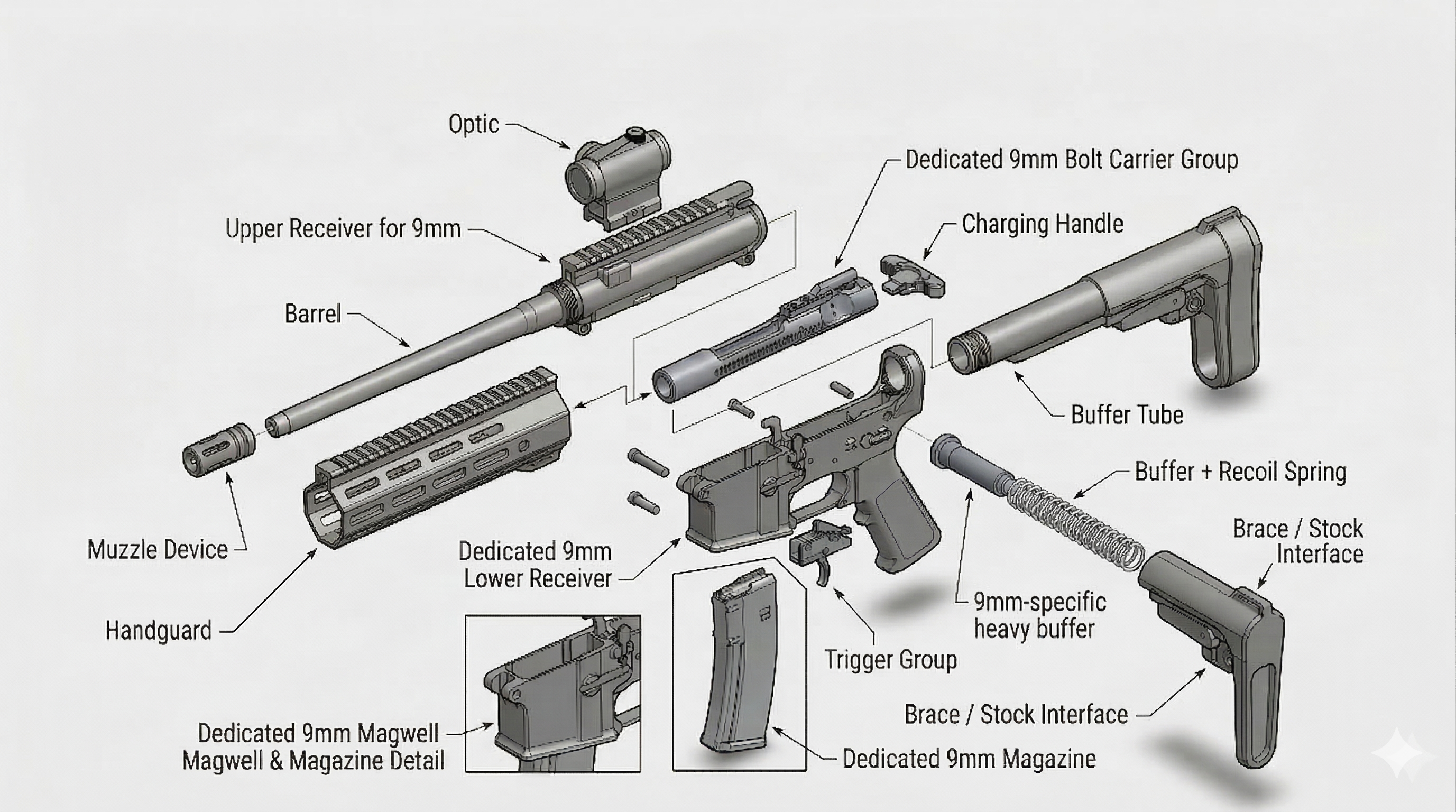
Reliability priority (foundation → top): Most failures start at the bottom. Prioritize magazine and buffer/BCG before optics or accessories.
| Priority | Layer | Focus |
|---|---|---|
| 1 (Foundation) | Magazine Reliability | Most failures start here |
| 2 | Bolt Carrier Group & Buffer System | Cycling and extraction |
| 3 | Barrel & Chamber Quality | Feeding and pressure |
| 4 | Optics & Mounting | Aiming system |
| 5 (Top) | Accessories (Lights, Grips) | Least impact on reliability |
2 – Parts Selection Framework
Rather than selecting parts based on marketing or aesthetics, this framework prioritizes:
- Reliability
- Ergonomics
- Durability
- Serviceability
Barrel Length Considerations
| Length | Characteristics |
|---|---|
| 7–8 in | Very compact, louder |
| 10–11 in | Balanced maneuverability |
| 16 in | Maximum velocity and legal simplicity |
Example build configuration: 10.5 inch barrel — compact, balanced ballistic performance, good suppressor compatibility.
Muzzle Device
The muzzle device threads onto the barrel and can serve as a thread protector, flash hider, compensator, or suppressor mount. For 9mm PCC builds, common choices include a simple thread protector, linear compensator, or a device that interfaces with a suppressor. Ensure thread pitch matches the barrel (e.g. 1/2×28 for many 9mm AR barrels).
Example: Thread protector or 9mm compensator — specify to match barrel thread.
Bolt Carrier Group (BCG)
The BCG controls: chambering, extraction, ejection, cycling.
Key considerations: Proper mass, nitride or phosphate finish, compatibility with blowback system.
Example: PSA Gen4 9mm BCG (Nitride)
Trigger Philosophy
Trigger weight should match the intended role.
| Purpose | Trigger Weight |
|---|---|
| Duty / defensive | 4.5 – 6 lbs |
| Range / competition | 3 – 4 lbs |
For reliability and safety, most defensive platforms prioritize moderate trigger weight and durable internals.
Charging Handle Selection
Ambidextrous charging handles improve manipulation under stress.
Example: Breek Arms Warhammer Mod2 Ambidextrous Charging Handle Benefits: Left/right manipulation, improved leverage, faster malfunction clearance.
Handguard Selection
Handguards provide: heat shielding, accessory mounting, improved grip control.
Example: Free-float quad rail handguard. Free-floating rails allow better accessory placement and reduced barrel interference.
Optic Mounting Principles
Red dot optics are common on PCC defensive platforms.
Example optic: Cyelee T10 red dot sight Key optic principles: Absolute or lower-1/3 co-witness, solid mounting surface, reliable battery life.
Stock or Brace Selection
For compact platforms, stabilizing braces may be used depending on regulatory environment.
Example: Magpul BTR Arm Stabilizing Brace Always verify current regulations before installation.
Practical Application (Section 2)
Use this section as a decision filter, not a shopping list:
- Lock in magazine system and buffer strategy before selecting accessories
- Keep the first build conservative (proven parts, standard geometry, simple controls)
- Defer optional upgrades until reliability baselines are met
3 – Reliability Engineering
This section is the technical core behind the “why AR9s fail” problem set: feeding, bolt speed, LRBHO, and ammo compatibility. Professionals think about carbines in terms of reliability systems, not parts.
The Reliability Pyramid
Reliable carbines prioritize components in this order:
- Magazine reliability
- Bolt and buffer system
- Barrel and chamber
- Ammunition compatibility
- Accessory setup
Most malfunctions originate in the first two layers.
Common Reliability Failures
| Issue | Causes |
|---|---|
| Feeding Issues | Poor magazine geometry, weak magazine springs, improper cartridge presentation. Magazine conversion systems (e.g. EndoMag) must be installed correctly for feed angle consistency. |
| Short Cycling | Incorrect buffer weight, weak recoil spring, low power ammunition. Symptoms: failure to eject, failure to feed. |
| Extraction Failures | Weak extractor tension, dirty chamber, improper bolt geometry. |
9mm AR Reliability Tips (Blowback-Specific)
Most 9mm AR-pattern platforms use simple blowback, so reliability is dominated by bolt velocity control: bolt mass, buffer weight, spring tension, and ammunition power.
Starting point (system-level):
- Think in combined moving mass, not a single part. Use manufacturer guidance as your baseline and tune from there with testing.
- Blowback systems foul quickly. Clean chamber, bolt face, and extractor area earlier than you would on a gas gun.
Ammunition compatibility (practical):
- Reliability depends heavily on power level and bullet profile. Verify the carbine cycles your chosen defensive load and your most common training load.
- Treat "one ammo runs, another doesn't" as a data point. Log ammo type, magazine ID, and round count with each issue.
Common malfunctions and what to check first:
| Malfunction | Most common causes | First checks (in order) |
|---|---|---|
| Failure to feed | Magazine geometry/spring, feed angle, dirty chamber | Swap magazines -> clean/inspect chamber -> evaluate bolt speed symptoms |
| Failure to eject | Extractor/ejector issues, under-powered ammo, bolt speed imbalance | Clean bolt face/extractor -> try known-good ammo -> evaluate recoil system setup |
| Short cycling | Ammo too weak, over-sprung/over-buffered | Try known-good ammo -> verify recoil system matches intended platform |
| LRBHO inconsistency | Magazine follower/geometry, bolt speed, bolt catch wear | Compare magazines -> check for battering/over-travel signs -> document frequency |
Tuning rule: Change one variable at a time, retest, and document.
Reliability Rule
Prioritize: Proven components > aesthetic upgrades.
Reliability is the foundation of a defensive platform.
Practical Application (Section 3)
- Diagnose in order: magazine -> buffer/spring -> bolt -> chamber/ammo
- Change one variable per test session
- Document every change and result before moving to the next variable
Get the full AR9 framework
$29 one-timeYou’ve seen the first sections of the preview. The full guide is built to answer the question every serious AR9 owner asks: will this combination actually run—especially with the ammo and mags I plan to carry?
Inside: feeding and HP compatibility thinking, LRBHO pitfalls, buffer and suppressor balance, a curated decision path (not brand hype), tools and safety, example setup, defensive configuration, zeroing and setup, common mistakes, the DCSS standard, setup checklist, compatibility matrix, worksheet, and printable blueprint—plus the kind of function-check discipline you’d expect from a professional framework.
- One-time purchase, lifetime access—peace of mind before you spend on parts
- Reliability-first: compatibility, tuning, and verification—not “close enough” guesswork
- System-level view: how components interact under real defensive use
- Includes free updates to this guide
- Instant access after secure payment